Mesh
Two receivers run shallow crossing routes from opposite sides and brush past each other in the middle. Man defenders get caught in the traffic; zone defenders see receivers flood their area. It’s one of the Air Raid plays that came straight from LaVell Edwards’ BYU.
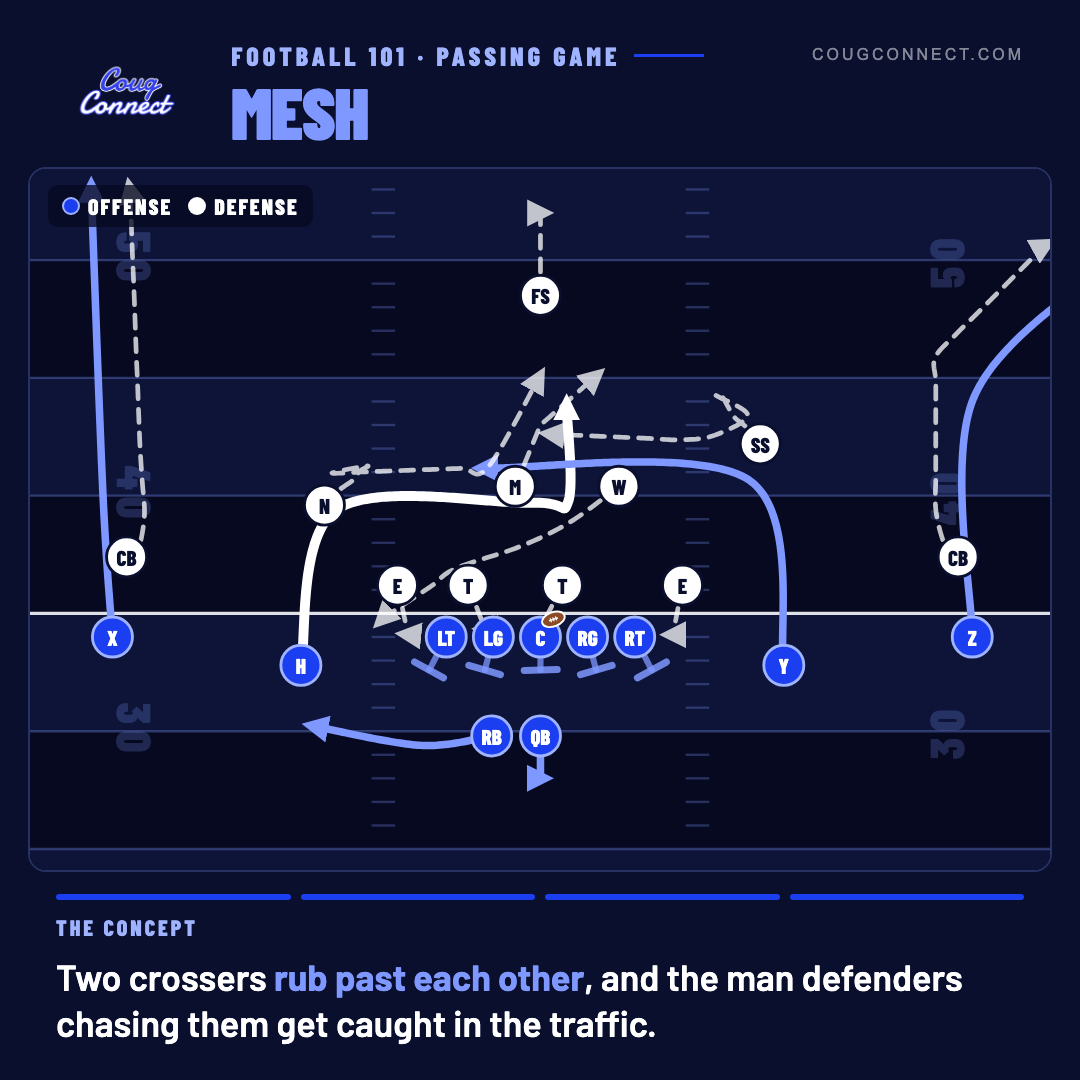
- Pre-snap: Man coverage: every receiver has a defender assigned to him.
- The mesh: Both slots run shallow crossers toward each other.
- The rub: They cross inches apart. The defenders chasing them have to fight through the traffic.
- Separation: The crosser comes out a step free, and that’s all the QB needs.
Film Room: an NFL example
Here is the same idea in a real NFL game, from the All-22 coaches film.
How it works
- Two receivers cross from opposite sides. One sets the depth at about 6 yards and the other comes directly underneath him; in practice they start by slapping hands as they pass.
- Against man coverage, the defenders chasing them run into each other (the “rub”).
- Against zone, the crossers settle in the open window. An outside corner route and a back’s swing add options.
Why it matters
It’s tough on man coverage (traffic) and zone (receivers sit in the holes), and the throw is short and fast.
The counter
Defenders “switch” crossers instead of chasing them, and a linebacker sits in the middle to wall the crossers.
Matchups
Good call against
- Cover 1: Crossers rub man defenders off each other.
- Cover 0: Rub routes beat pure man with no help.
- 2-Man: Rubs are one of the answers to 2-Man.
Struggles against
- Brackets, double coverage and banjo: Banjo and switch rules keep man defenders from getting picked.
What to watch for: Two receivers crossing so close they almost touch, about 5 yards downfield.
Also called: mesh, Air Raid mesh