ASU In Review
Well ladies and gentlemen, I don’t want to spend a lot of time here dwelling on the past now that Holy War week is here. I’d be remiss though if I didn’t at least talk a little bit about the ASU game. We won’t get into the referees being abysmal at their job, or even the frustration felt by the fans in the stands as they watched a 17-3 lead melt away with another bad 3rd quarter.
I want to get into grading out the keys from last week and look ahead to a game that we all have circled every year.
- Wrap Up: Grade – C
ASU ran for 151 yards on 28 carries with a 50% Rush Success Rate. The BYU defense only stuffed 1 run. Overall it was statistically better than against UCF, but I’d like to see the run fits being better and a continued effort at getting better at wrapping up. - Win Early Downs: Grade – C-
The boys on offense had a 37.5% Early Down Success Rate which is down ~10% from their baseline (a baseline that is good for #19 in the country) They held ASU to under a 40% Early Down Success Rate too so it wasn’t terrible on that side of the ball but it wasn’t great either. - No More Three-And-Outs: Grade – D
Three of them. And while you are at it, you could potentially add the other 2 drives in which BYU had turnovers on the 3rd play of the drive. Consistent offenses move the ball. Handing the ball to your opponents multiple times without taking virtually any time off the clock and not giving your defense a chance to catch their breath is not a recipe for success. - Protect the Ball: Grade – D
This is the 4th straight game that BYU is negative in the turnover margin. A careless fumble and another untimely middle 8 pick took points off the table getting into quality drive territory. They are going to need to be even or positive in the turnover margin against Utah if they want to keep the streak alive.
The boys got the W though, and the most important stat of all is the score. I am fully expecting a much more focused team on Saturday, a la how they were against Notre Dame and not whatever these last 2 weeks have shown us from this team.
It’s time for the Holy War
(From here on out, we’re back to our opponent-adjusted stats that exclude garbage time and games against FCS opponents)
If you have not subscribed to CougConnect yet, what are you doing? You’re missing out on a ton more articles and access to the CougConnect Discord server where hundreds of passionate BYU fans hang out daily to talk all things BYU sports. Get signed up and come on over to the best place online for Cougar fans! You are directly contributing to grassroots BYU NIL and the perks on top of the Player AMAs and articles are awesome!
Your CFP Ranking #9 BYU Cougars head up the road to take on the 8-0 #3 Utah Utes in one of the top 3 most intense rivalries in the country! So what do the stats and projection models tell us about this game? (Understand that this is a rivalry game and you can possibly throw “typical” performance stats out the window in this game.)

Now, I am not going to pretend that Utah is not a good team. On the contrary, I think they are a very good team, even a borderline great team. This is a week though where Vegas and the Model agree, and I think they are up in the night and flat out wrong.
I’m going to break down why over the next bit, but I want to call out the fact that no matter how close or far you think the scoring margin will be in this game, you’re probably wrong. In the last 3 meetings between these two teams, the underdog has covered the spread. In 2021 BYU was a 7 point dog at home ended up winning 26-17. In 2024 BYU were 3 point favorites at Rice Eccles Stadium and Utah covered the spread despite their heartbreaking last-five-second loss on the leg of BYU legend Will Ferrin. In 2025, BYU was around 4.5 point dogs at home again in a game that they won by 3 after a desperation drive by Utah and a failed onside kick. Go ahead, make BYU the underdog, they’ve thrived in that role the last few seasons.
So where does a victory start for BYU on the road against a red-hot undefeated Utah team that is looking to break the streak of losses at BYU’s hand?
Utah hasn’t played a defense of quite this caliber yet
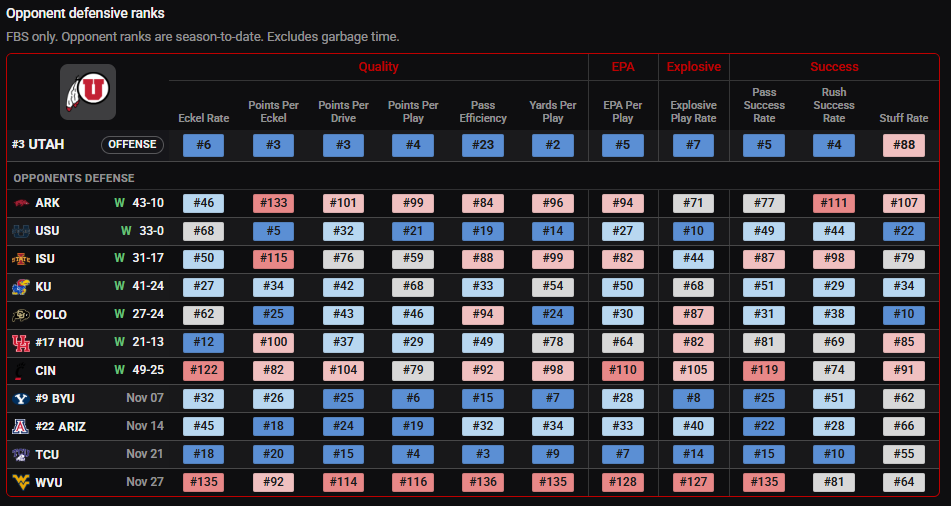
For the last 2 seasons, I have referred to Utah as the litmus test of great teams. If you were not a Good-to-great team defensively, Utah would flat out embarrass you (see the many blowouts Utah has had against statistically bad teams, including Cincinnati above who has the 2nd worst defense Utah will see all season). If you were a good to great team, you would go toe to toe with Utah (and in a large percentage of cases, Utah would end up losing that game). This year, we get to put this theory to the test again, as Utah got their first win against a ranked opponent in Devon Dampier’s tenure against a Houston team that is Good but in my opinion not “Great”. (ESPN FPI and efficiencies tend to agree with Houston being the #10 offense in the country, but paired with the #57 defense in the country)
Admittedly, BYU’s defensive stats have taken a bit of a dive after their win against Notre Dame, but to be fair to BYU, that was one of the biggest wins in BYU history and they didn’t know how to handle success like that. They needed another big game to bring back the focus and attention to detail, enter the undefeated Utah Utes in both teams’ biggest rivalry. BYU for all intents and purposes is a “Great” team. Not necessarily Elite though.
Looking at the chart above, it shows a bit of a heatmap of the ranks of defenses that Utah has faced. In the games that Utah has had a bit of a struggle in, they were playing against defenses that could do one thing well.
- Houston has a great defense at preventing quality drives from their opponents (Eckel Rate) to the tune of being #12 in the country. They held Utah to 0 points in the first half and if not for some heroics by Devon Dampier (more on him later) and a timely blitz-turned-forced-fumble inside of Houston’s own 20 yard line, Houston did a pretty great job of keeping Utah from playing their style of game.
- Colorado is #10 in the country in Stuff Rate and #24 in Yards Per Play Allowed. They made Utah extremely uncomfortable in a tight game.
You would probably not call BYU’s defense Elite in any one category, but across the board they have statistically been top 25 in many of the statistics against a harder slate of opposing offenses than Utah thus far. Putting them squarely into Great category at minimum, and they’ve done this against a decent slew of offenses to date including Notre Dame and Arizona.
Now how about the other side of the ball?
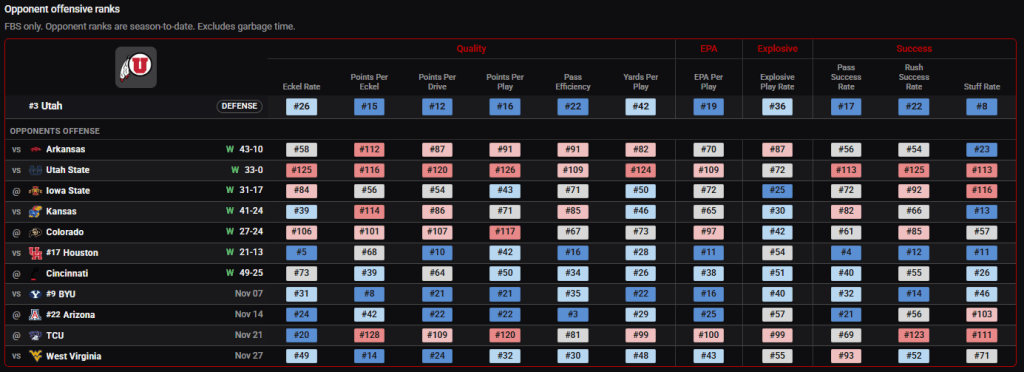
This is one area that Utah takes great pride in, and given Morgan Scalley’s heritage, there are no surprises there. In Utah’s 7 FBS games so far this season, their opponents who have been averaging 24.9 PPG in non-Utah games only averaged 16.1 PPG against Utah. Each team that has faced Utah has had a lower-than-average Success Rate on a per-play basis. But let’s look further at the offenses in that table.
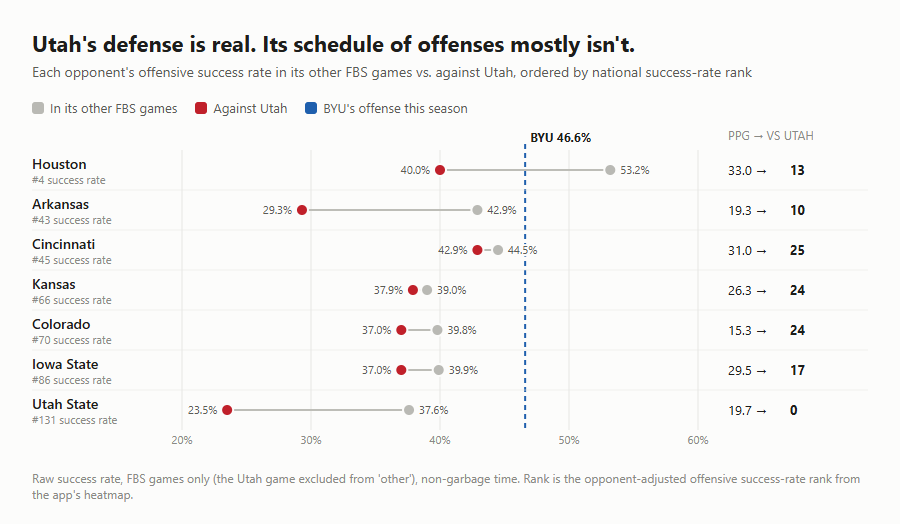
Only one offense that Utah has faced this season has been among the top 40 of offenses in regard to Success Rate. Houston is the first real test that Utah faced all season. Admittedly, Houston did pretty well, but the environment for this Saturday’s game is going to be substantially different than the Houston environment for a myriad of reasons. Firstly, this is one of the oldest rivalries in the country, BYU is no stranger to playing at Rice Eccles Stadium. This trip to Salt Lake was Houston’s 2nd ever trip and the first since 1977. They caught Utah in a blackout night game, on an after-9:00pm body clock kick, with a hyped up College Gameday Crowd.
BYU has played there 21 times in that same timespan. Many of the coaches on BYU’s staff know what the environment at Utah is like. Many of the players on the team have already made the trip to RES as well (or played there in the case of some). Much to the chagrin of Ute and Cougar fans alike, the game is also slated to be kicked off at 10:00am local time. There will not be a large amount of time to build the anticipation and the hype all day long like fans of both teams would prefer.
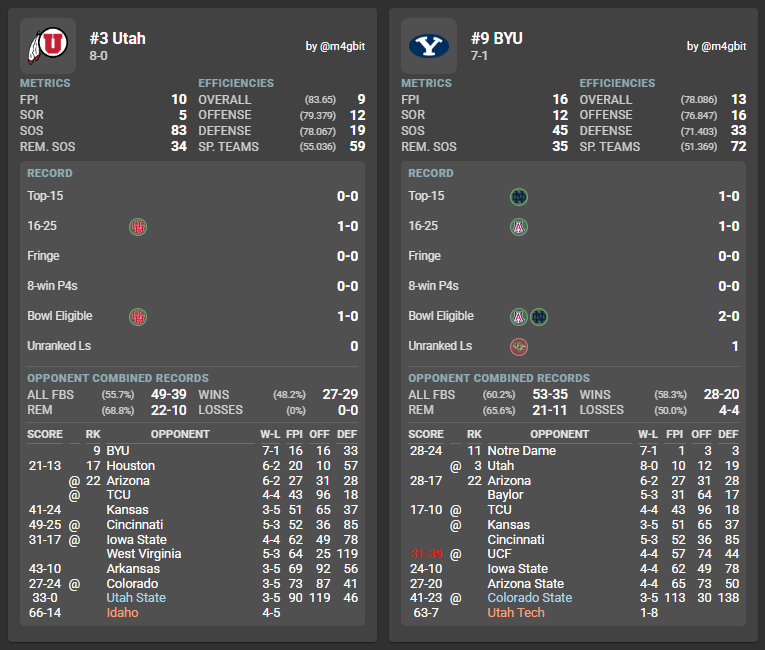
Looking at the resume cards for each team above (say what you will about ESPN FPI metrics, but they’re easy to import and present) we can see that BYU has been tested more times by Top-30 statistical teams than Utah has and has played a schedule that is 38 ranks tougher than Utah’s to date. Even with opponent-adjustment of the stats, it’s not really an apples to oranges comparison.
So what comps can we draw for BYU?
If you want to know how BYU handles an offense that is as efficient as Utah’s, we already have a team-comp for reference’s sake, as we are just 3 weeks removed from BYU’s enormous upset of Notre Dame as 10 point dogs in Vegas metrics.
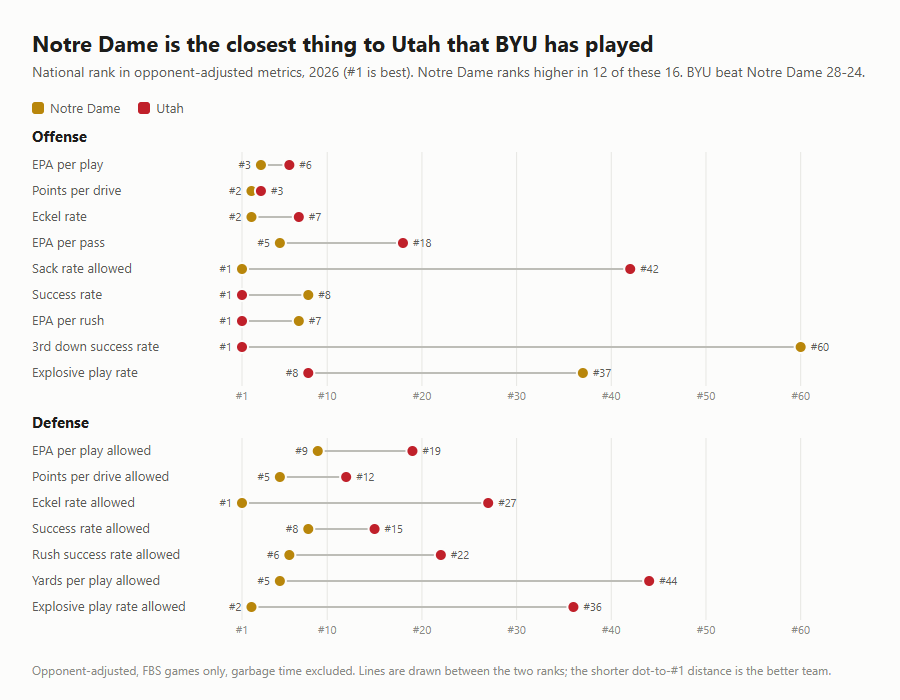
Looking at Notre Dame’s stats profile compared to Utah, we can see that Notre Dame is the team with the better rankings/stats in 12/16 of the metrics. Where Utah is better is probably on the ground and in regard to giving eye-candy to create explosive plays for their offense. Knowing the results of BYU’s game against Notre Dame, we can see how BYU’s performance affected Notre Dame’s efficient team on both sides of the ball relative to their norm (with a SOS of #55 which is still nearly 30 ranks above Utah’s SOS).

Notre Dame’s offense was held to just 24 points, their fewest of the season. Their 38.5% Success Rate was also the lowest of the season by 8 percentage points. The Fighting Irish rushing attack came into the game boasting an insane 50.7% Rush Success Rate and were held to just 34.5% against this stout BYU front seven. Contrarily, BYU’s 28 offensive points were the 2nd most points that Notre Dame had given up to opposing offenses in the entirety of the past two seasons, and the first time since Notre dame’s 41-40 loss at the hands of Texas A&M in September 2025. BYU’s 48.5% Offensive Success Rate is also the best mark that any team has put up against Notre Dame on the season. BYU is perfectly capable of getting up for the big games. And put into a do-or-die playoff situation this Saturday, we can bank that BYU is going to show up to play.

BYU gave fits to Notre Dame in many of these stats but there is definitely room for improvement in some of these areas. For one, BYU spent a solid amount of time getting pressure on CJ Carr, but struggled to get him to the ground and didn’t record a single sack in the game. They also struggled to get Notre Dame off the field on 3rd down (a struggle I will get more into later). Coming into the game, Notre Dame’s Defense was top 3 in Points Per Drive, Success Rate Allowed, and Explosive Play Rate. Notre Dame was top 3 in the country in the 7 metrics above and ranks ahead of Utah in each of those.
So how does BYU pull off the upset?
As many great games do, this game is going to come down to which team can win in the trenches. And against stiffer competition, BYU has done just that all season. So let’s take a deeper dive into the trench stats we can pull and delve into the world of Kelly Poppinga’s domain, HAVOC.

Sacks, TFLs, and Havoc Rates for each team, made vs allowed tells a bit of a different story than the stats posted above in the head to head comparison section of the article.
This BYU team is +13 in sack margin (Utah +6) and has given up a grand total of 5 sacks all season while forcing 18. (Utah, 10 and 16 respectively. This Utah front has allowed twice as many sacks as BYU’s O line despite playing a weaker schedule). To add to that complete chaos, BYU is also +28 in TFL margin on the season allowing just 17 TFLs and delivering 45 to opposing offenses. This is a stat in which this “vaunted Utah defense” has recorded 8 fewer total TFLs and the Utah offensive has allowed 27 more than the BYU offense.
In regard to pure havoc, this BYU team outperforms Utah in each of the remaining havoc categories. I am especially interested in Utah’s -1.5% NET front-seven Havoc rate. This shows that their offense has struggled against havoc from the front 7 than they deliver to opposing teams. Sure they have gotten very creative with their blitzes from the edges and creating havoc in that way, but BYU’s game plan should not allow Utah to get the same pressure that they did against Houston, especially from the edges and depth.
We’ve seen what happens when these two QBs go head to head
One thing that is not different between the teams this year is the QB situation. Bear Bachmeier and Devon Dampier will once again go head to head in a battle for state supremacy. Last year in Provo as a true freshman, Bear Bachmeier recorded a 137.5 Passer Rating and a QBR of 91.5 on the back of going 13/22 (59%) for 166 yards with 1 touchdown and 11 carries for 64 yards (5.8 avg) and a score. Devon Dampier on the other side of the coin went for a 125.3 Passer Rating and a 79 QBR on a 20/36 (55.6%) for 244 yards, 2 scores, and a costly interception that set up BYU’s game winning TD drive. He also added 15 carries for 64 yards (4.3 avg) on the ground and 0 scores.
Many people do tend to overlook that prior to that herculean final drive for Utah to try to make it a 1 score loss, Devon Dampier was sitting at 15/31 (48.4%) for 200 yards. Not the greatest of games through 57 minutes for a QB who typically averages well into the 60% range. On the ground BYU held Dampier to a 25% Rush Success Rate, which is a number to pay attention to as Dampier has been averaging a staggering 58.6% Rush Success Rate on the year so far. The Utah offense runs with Dampier.
So how does BYU combat the Utah Rushing attack?
The answer is simple really. You take your “Goshdarn” (H/T Portland State coach) Centaur QB and you add back the return of the defending Big 12 Offensive Player of the year in LJ Martin. LJ hasn’t seen the field since early on in the TCU game in October. Kalani Sitake went on record earlier his week saying that LJ is “getting really close” and On3 as well as Pete Thamel have reported that he’s aiming to be back for the Holy War. He’s since been upgraded to a “questionable” tag in the required Big 12 injury reports. Nothing is official yet, but should he play, even at 80%+ of normal, this is what BYU is getting back in their backfield.
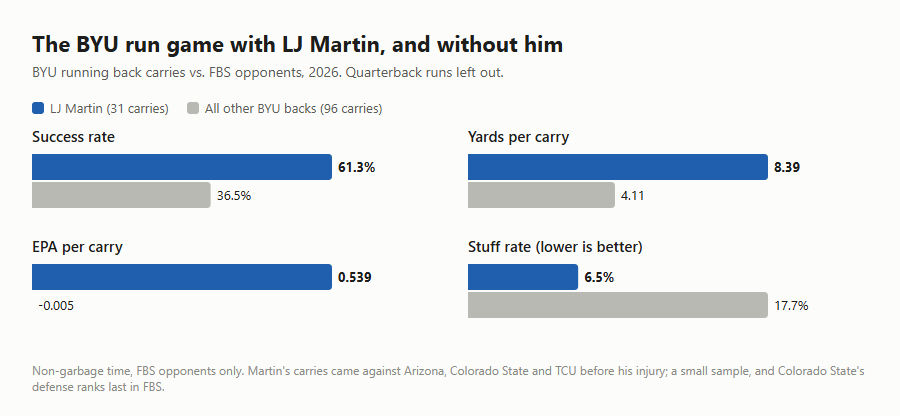
There are no two ways to slice it. LJ Martin is one of the best running backs in College Football. Full stop. He gives BYU’s offense an element that they have been sorely missing in their past 4.5 games. A Battering-Ram not named Bear Bachmeier. Now, do we expect an LJ Martin who has missed roughly 5 weeks to be a 100% contributor for the entirety of the game? Your bet is as good as mine, but LJ doesn’t need to be on the field for the entire game, and even if he ends the game with only 5-10 well-timed touches, he alone could be the difference between a failed 3rd and short conversion and a chain-moving 1st Down.
Paired with all this excitement too is the return to the lineup of Preston Rex, BYU’s RB4 who had a fantastic outing against Notre Dame and made big plays when they were most needed.
A few more threads to chase
If you go back to the head to head comparison, there were a couple of matchups that stood out the most to me.
- BYU’s Pass Defense vs Devon Dampier’s arm.
BYU is #4 in the country in Yards Per Pass Allowed this season (4.47) and #16 in the country in Pass Efficiency Defense. Utah’s best passing outing of the season came just barely against a Cincinnati team that ranks #125 in the country in EPA/Pass. - Bear’s Protection vs Utah’s Rush.
This has already been covered a bit in the havoc section, but it bears mentioning again (pun intended). BYU is #9 in Sack Rate allowed going against a Utah defense that is #115 in Sack Rate. Utah loves to send pressure, but thus far BYU has done a tremendous job of handling said pressure either with scheme or just making plays. - Both of these teams are in the mid 90s to 100 in regard to offensive plays per game. This is going to be another low-possession, low scoring slog-fest which is going to result in more variance to the game. Variance as they say, is the friend of the Underdog.
So How about this Utah Passing Attack
There’s really no way to sugarcoat or hide the fact that Utah’s offense has a little bit of a problem. They are not balanced. And you may say “Steven, what are you talking about. They have really good offensive balance. They’re running the ball almost exactly 50% of the time (sans garbage time)” and to that you’d be right. But they are tremendously imbalanced in their passing attack.

Devon Dampier has a bit of a short-right tendency, with 45% (60/140) of passes going to this area of the field in conference play. Until you chart it out, you may not notice the fact that the Utah offense goes this direction more than 50% of the time in their passing attack. And would you believe it or not, this section of the field is BYU’s best-area of defense this season.
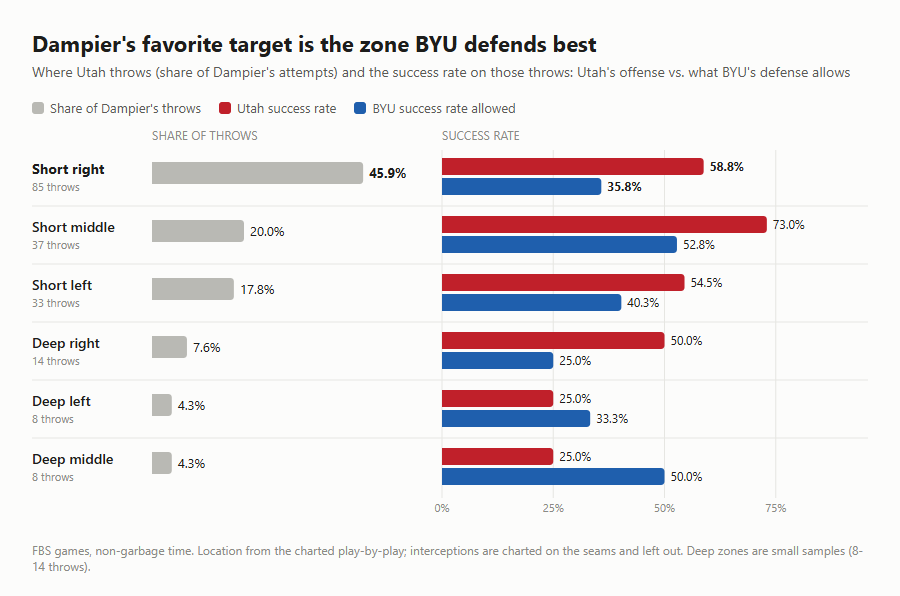
This doesn’t necessarily mean anything… unless of course the BYU defense has either noticed this tendency or been made well-aware that this tendency exists and that their DBs have it on their radar that there’s a 50% chance they’re going to be targeted on passing plays in this area of the field.
So let’s wrap it up and give some keys to BYU winning this game
We’ll also call out a few areas that Utah may be able to flex some muscles to win this game should BYU not be up to the task.
- Live in Utah’s backfield AND WRAP UP
KPop’s mantra this year has been HAVOC. This Utah team has allowed 44 TFLs on the year. Even if you can’t get to Dampier on passing plays in the pocket, Utah loves to get creative with their flashy offense that gives you a lot of eye-candy and options to have to sort through in a short amount of time. Play disciplined, do your job, and stay assignment-sound. Once you have locked in on your keys, get home and wrap up. - Keep Dampier in the Pocket
A year ago, BYU’s defense held Dampier to a 25% Rush Success Rate. He’s been hovering just a touch under 60% in this stat on the year so far. Fit the runs and force him to beat BYU through the air against the #4 pass defense in the country (by some metrics). Also probably worth paying attention to whether or not you are on the right side of the field. - Win 3rd down
BYU is going to need to win 3rd down in this game if they want to spring the upset and keep their CFP and CCG hopes alive. They should be able to win on early downs. The key will be actually wrapping up tackles and getting off the field when you have won the down. - Protect the ball
BYU has been -1 in turnover Margin 4 consecutive weeks.
And here are a couple of key areas that I will be paying very close attention to for signs that Utah may be on their path to victory in this game:
- Utah starts Gashing BYU on the ground.
- The missed tackles that have plagued BYU’s defense this season keep continuing to pile up.
- The Defense cannot get off the field on 3rd down.
- 4th downs. Last year Utah failed abysmally on 4th down. If they start getting gutsy enough to go for it at home and the plays start landing, BYU better make adjustments quickly.
- Utah’s DBs are responsible for havoc on 10.3% of plays, this is the highest DB havoc rate BYU will have faced this far on the season, and Utah is no stranger to turning a giveaway into 6.
Well, folks. This is going to be a Holy War for the ages. Vegas, the models, the talking heads, everyone seems to be doubting this BYU team that we know plays well as the underdog. It’s nice that they are going into Salt Lake City with no reason to hold anything back. That is why I project that BYU wins this game 24-17 in an instant classic.
Subscribe to CougConnect, or you can find me on Twitter/X @m4gbit.
Go Cougs! 4 is coming!