The Cougars carry their highest preseason ranking in four decades into Saturday’s opener. A true freshman starter, a loaded tight end room and a seven-touchdown number tell you how it got here.
The last time BYU began a season ranked this high, LaVell Edwards was defending a national championship. The 1985 Cougars opened at No. 10, and no BYU team since has started higher than this one.
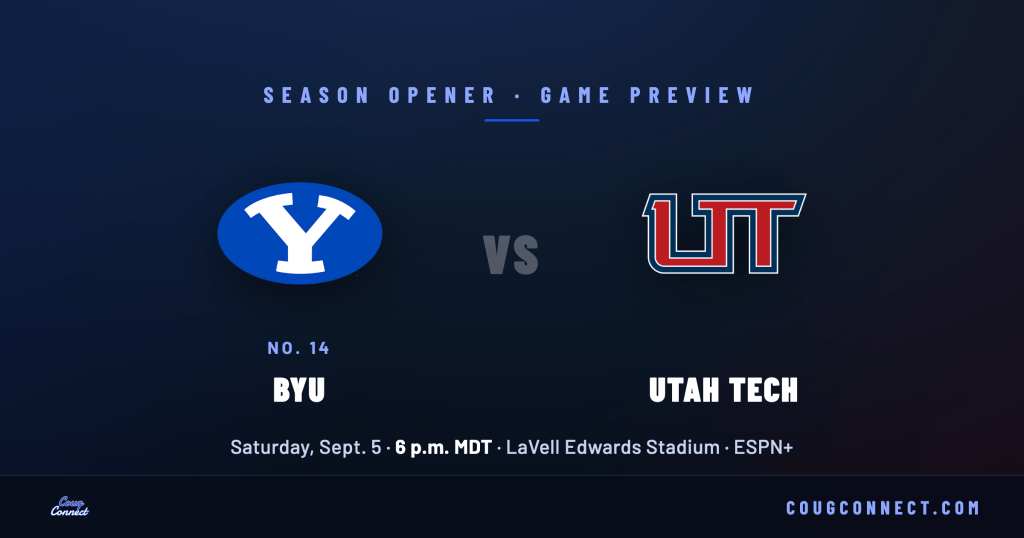
That is the backdrop for Saturday, when No. 14 BYU opens the 2026 season against Utah Tech at LaVell Edwards Stadium (6 p.m. MDT, ESPN+). The Cougars are coming off a 12-2 campaign that ended with a comeback win over Georgia Tech in the Pop-Tarts Bowl and a No. 11 finish in the final AP poll.
Kalani Sitake has spent August calling this the deepest roster of his tenure. Saturday is the first chance to check his math.
How camp set this up
Start with the quietest storyline, which is also the most important one: nobody got seriously hurt.
“We’re showing up relatively healthy — probably healthier than what we’ve been in years past,” Sitake said as camp wrapped. Staying healthy was priority No. 1 on our fall camp list a month ago, and BYU checked that box.
Bear Bachmeier checked a few of his own. The sophomore quarterback dropped roughly 15 pounds in the offseason and spent camp throwing to the tallest receiver room in program memory. “As accurate of a thrower as I’ve ever coached,” offensive coordinator Aaron Roderick told the Deseret News — and Roderick is in his sixth year calling BYU’s offense.
The receivers noticed too.
“I think we’re a lot better than, honestly, I thought we were going to be,” Kyler Kasper told the Deseret News after the final major practice of camp. The 6-foot-6 Oregon transfer said Bachmeier has “already progressed so much since even spring ball when it comes to reading the defense… Everything has gotten way better.”
Kasper had one more observation about this roster: “I have not been on or even seen a team this big.”

The locker room settled its own question before the depth chart came out. Players voted eight captains — Bachmeier, LJ Martin, Bruce Mitchell, Roger Saleapaga II, Cade Uluave, Keanu Tanuvasa, Isaiah Glasker and Evan Johnson — and two of them, Uluave and Saleapaga, have yet to play a down for BYU.
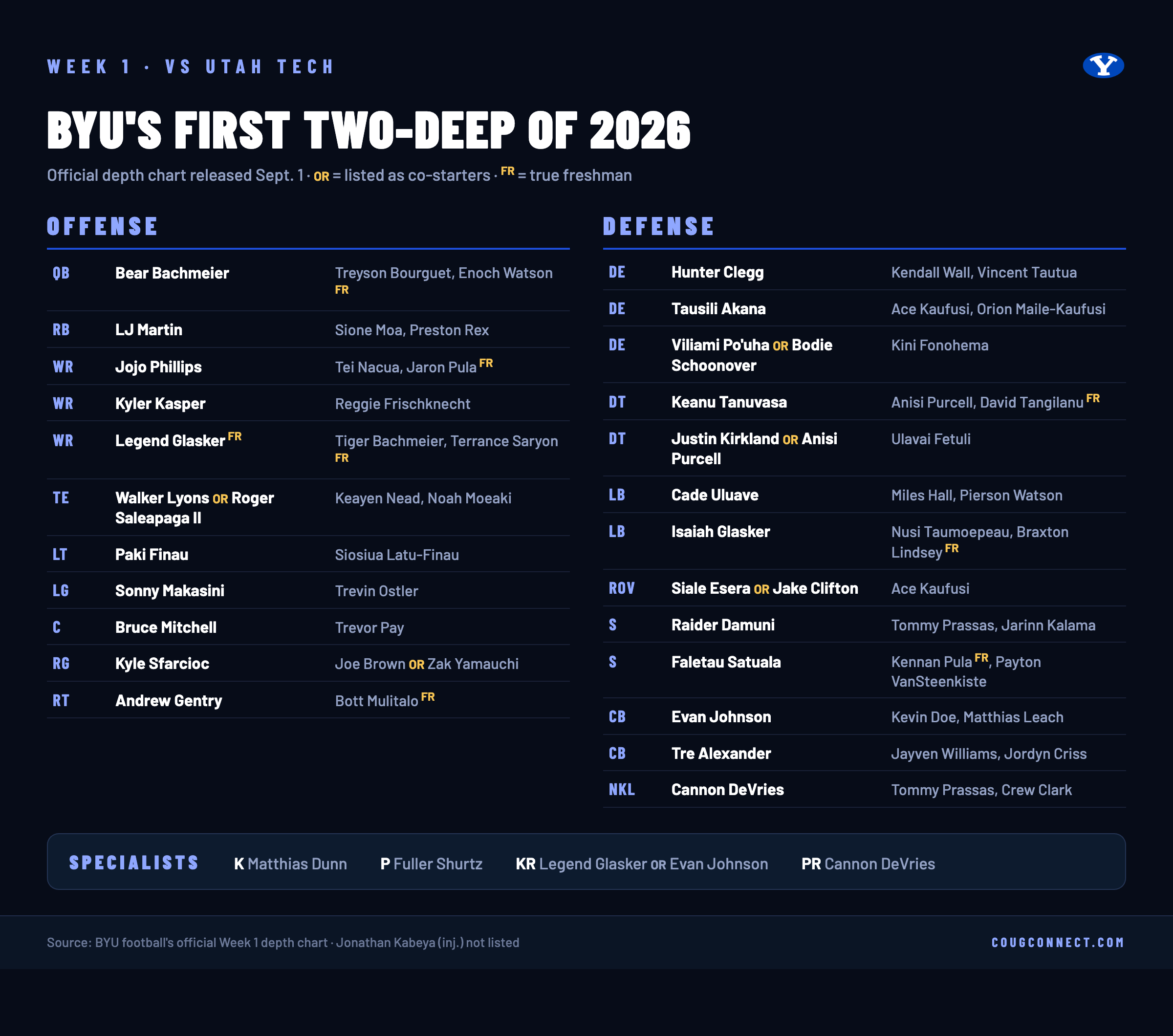
BYU released its first official depth chart Monday. Here is what it, and three weeks of August, tell us about Saturday.
(The August homework, if you’re catching up: a player to watch at every position and our four breakout picks.)
A Legend makes his debut
The name on the chart that tells you the most about this team’s direction is a true freshman’s.
Legend Glasker — 6-foot-1, 175 pounds, out of Lehi High — is listed as a starting receiver alongside Kasper and Jojo Phillips. He is the only true freshman starter on the team, and he is also the first-team kick returner next to All-America cornerback Evan Johnson.
Glasker graduated from Lehi in December to enroll early, then spent spring and fall running past people. “It’s a credit to him how he’s picked up our playbook, and how smart he is,” receivers coach Fesi Sitake said in August, admitting he didn’t anticipate a freshman claiming the job.
The last name is not a coincidence. Legend is linebacker Isaiah Glasker’s cousin — his grandfather and Isaiah’s father are brothers — which means the family has a starter on each side of the ball.
He is one of eight true freshmen on the initial two-deep, along with safety Kennan Pula, lineman Bott Mulitalo, edge Braxton Lindsey, tackle David Tangilanu, quarterback Enoch Watson and receivers Terrance Saryon and Jaron Pula. On a roster this experienced, that many freshmen forcing their way on is the depth Sitake keeps talking about.
Two tight ends, one problem
BYU will start two Power Four transfer tight ends: Walker Lyons, by way of USC, and Saleapaga, by way of Oregon. Both are 6-foot-4. Both can block and catch. Roderick has called them “two of the best players on our team,” and around the program the comparison being floated is the best BYU duo since Dennis Pitta and Andrew George in 2009.
Expect plenty of 12 personnel — both tight ends on the field — which forces a defense to pick between size and speed and lets Roderick hide run and pass in the same look.
Saleapaga is the sneaky breakout candidate of the two. Oregon used him mostly as a blocker last season; his teammates just voted him a captain before his first BYU snap.
The front seven’s first look
Saturday is also Kelly Poppinga’s debut calling the defense, and the depth chart hints at how he’ll do it: 13 defensive positions are listed, a tell that BYU will be multiple up front and lean on a nickel package.
The interior is the headline. Keanu Tanuvasa, a preseason first-team All-Big 12 pick, and Justin Kirkland give BYU as good a tackle pairing as anyone in the conference. “We just got playmakers all over the place,” Kirkland said during camp.
Off the edge, watch for Nusi Taumoepeau, back from the Achilles injury after what coaches called an ultra-impressive camp, and for Lindsey — a true freshman listed third at linebacker who is nonetheless expected to take first-team pass-rush snaps. Texas transfer Tausili Akana adds another body to a room BYU built specifically to win with four rushers.
Behind them, Uluave and Isaiah Glasker anchor a linebacker group that drew best-in-school-history talk in August. In the secondary, safety Faletau Satuala — a second-team All-American who broke his foot in June — has been cleared for the opener, and sophomore Cannon DeVries starts at nickel with Jonathan Kabeya out injured.
CougConnect
Watch this season with the rest of Coug nation.
Game threads every Saturday, player Q&As, locker room talk — plus the members-only Discord where the community works through every depth chart change in real time.
The other sideline
Utah Tech arrives 0-1 in its first season as a Big Sky program, and a week removed from a hard night: a 54-0 home loss to No. 1 Montana State, the defending FCS champion, in which the Trailblazers managed 227 total yards.
Third-year coach Lance Anderson hasn’t named a starting quarterback. Returning starter Bronson Barben (1,682 yards a year ago), Utah State transfer CJ Tiller (10 of 12 for 91 yards against Montana State) and former Wisconsin and Iowa passer Deacon Hill split the job in Week 0 to no resolution.
The names to know are running back Ace Chatman, who led the team with five touchdowns last season, tight end Kaden Eggett, and a pair of linebackers: Daylen Love, who put up 60 tackles as a true freshman, and Will Alovao, who led the team in tackles for loss. The roster carries 34 Utah high school products, so plenty of players in red will know the building.
The programs have met once. BYU won 52-26 in Provo in 2022.
The number
As of Tuesday, the books have BYU as roughly a seven-touchdown favorite — most lines sit between 47½ and 51½ points, with a total around 61½.
A number that size makes the score less interesting than the process. What a good Saturday looks like: a fast start from the first offense, a defense that gets off the field on third down, and a fourth quarter that belongs to the twos and threes — the depth reps BYU spent camp preparing for.
Five things to watch
- The opening script. How quickly Roderick goes to Kasper and the tight ends, and whether Bachmeier takes a deep shot early to a receiver room built for them.
- Glasker’s first touch. It may come on a kickoff before it comes on a route.
- 12 personnel. Count how often Lyons and Saleapaga are on the field together.
- The new leg. Matthias Dunn takes over for Will Ferrin. “I feel really good about the third phase,” Sitake said — Saturday is the proof.
- How early the twos play. The sooner Watson, Saryon, Eka and the rest of the freshman class see the field, the better the night went. The all-royal uniforms with white pants — a first in the Big 12 era — should be on a lot of bodies by the end.
One thing the depth chart refused to settle: Rover, where returning starter Siale Esera and Kansas State transfer Jake Clifton share an “or.” Saturday probably won’t settle it either. But one of them runs out of the tunnel first.
We’ll be watching together — the game thread opens in the members’ Discord at kickoff. Here’s how that works.