What a ride is has been for Cougar fans so far. Knowing where we came from at the end of last year and losing 5 straight, navigating through the offseason and the doubts surrounding the program and straight on into a 5-0 start with 2 wins against current AP Top-25 teams.
I want to take a moment and contribute a statistical snapshot and look into some of the measurable statistical differences between this year’s team and last. I am going to start by walking through something that I post on my Twitter/X Page weekly during football season for all teams in the Big 12.
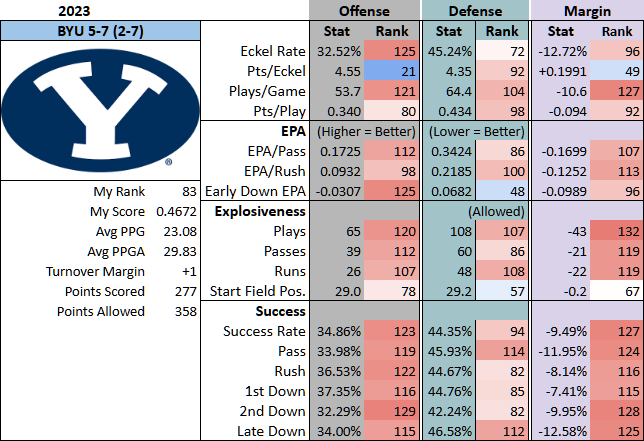
What you are looking at here is what I refer to as a “Stat Breakdown”. If you get frustrated seeing a lot of red, this chart may give you some anxiety, but I promise that if you stick around to the end, you will feel a lot better about our current situation. Now, you may look at this chart and be completely overwhelmed as to what this mess is trying to say, but now that I have let you into my brain, let me try to explain a bit and attempt to help you see things the way that I do.
I’m going to start by defining some terms to help you understand the data and then explain how to consume this data. So here are some definitions you will find useful.
Definitions
Garbage Time – The point in the game where it is essentially over though there is still time on the clock. Garbage time is met when there is a scoring margin over 38 points in the 2nd quarter, over 28 points in the 3rd quarter, or over 22 points in the 4th quarter. I exclude garbage time drives/plays from all of the data I collect because teams change the way they play when they are just trying to ice the game and get to zeroes.
Eckel Rate – The rate in which you (as a team) have what is referred to as a “Quality Drive”. A Quality Drive is simply a drive in which you either score points or you have a 1st down inside your opponent’s 40 yard line. The formula for Eckel Rate is (Number of Quality Drives)/(Number of Drives). This metric is a measurement of consistency. It answers the question: “How consistent are you at moving the ball into a scoring position?” A higher Eckel Rate for an offense means you are consistent. From a defensive perspective, a lower Eckel Rate indicates success because it shows that your opponents have a hard time being consistent against you.
Points/Eckel – How many points (on average) your team gets (or allows in the case of defense) on each Eckel Drive you have. This metric answers the question: “When you put yourselves in scoring position, are you more likely to walk away with a TD, a FG, or nothing?” From an offensive perspective, higher numbers are better. From a defensive perspective, lower numbers are better.
EPA (Expected Points Added) – A measure of how likely you are to improve your score based on a number of data points including where you are on the field, what down and distance you have to go, and its relation to where you end up on your next play. We want to see higher numbers offensively and lower numbers defensively. A negative number (in regards to offense) indicates that the other team is more likely to score than you are given the criteria of the situation.
Explosive plays – Explosive plays are the exciting chunk plays that can turn the tide of the game. They are defined as Rushes of 12+ yards and Passes of 15+ yards. Offenses want a balanced offense with a lot of explosive plays and defenses want to prevent explosive plays from happening.
Success – Success is measured based on the down and distance. A successful play is a play that gets 50% of the remaining yards on 1st down, 70% of the remaining yards on 2nd down, and 100% of the remaining yards on 3rd/4th down (synonymous on 3rd and 4th down with 3rd/4th down conversions). For example, a 7 yard gain on 3rd and 8 is not a “successful” play, but a 7 yard gain on 2nd and 8 is as it puts you in a great spot to convert on 3rd down.
Evaluating the data
Now that we have those definitions out of the way, let’s actually take a closer look at part of that scary chart from above.
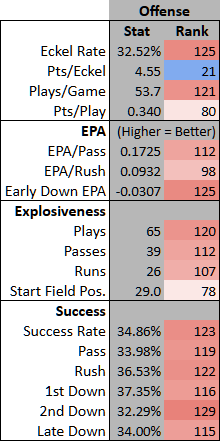
At a glance, we can see that in 2023, BYU’s offense was having one quality drive in roughly almost every 3 drives (good for #125 in the nation among FBS teams) and had a whopping 4.55 points per quality drive. (#21 in FBS)
What data can we infer from the combination of those metrics? We can infer that BYU was inconsistent at moving the ball, but when they did, they were scoring TDs among the best of the teams in the country.
BYU did not control most of the games they played (low Plays/game).
BYU also had very little success consistently throughout the season as indicated by the Bottom-20 rankings in nearly every Success category I track.
Defensively, we didn’t fare much better down the stretch of the season, but actually started out 2023 with decent metrics that faded down the length of conference play as injuries took hold.
What about now?
Now that we have looked at the metrics from last year, let’s take a look at how they have changed through the first 5 games in 2024.
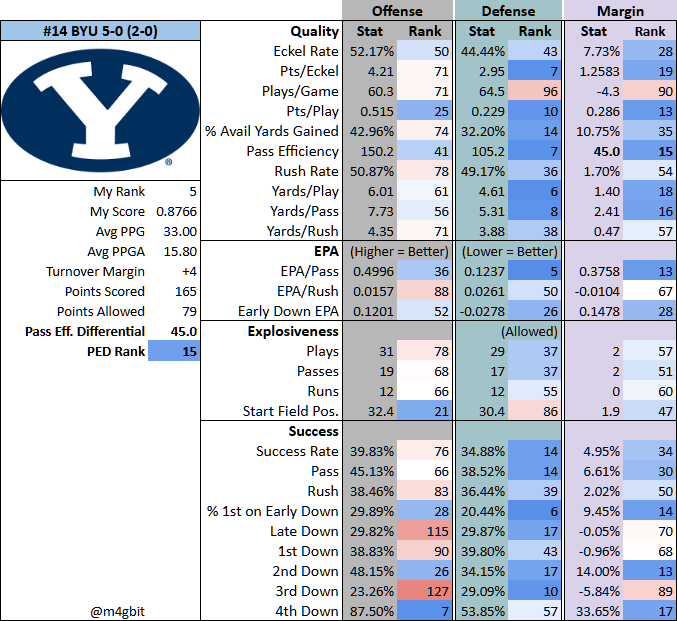
Things you might notice at a glance in the image above:
- Substantially more blue this year. (Blue = Ranked in the top 50% of FBS teams, the darker the blue, the better rank)
- Defense will be considered “elite” (Top 10 in FBS) if they keep up their current trends.
- Offensive Eckel Rate up ~20%. The offense is more consistent.
- Average Points/Game up ~10.
- EPA/Rush down from last year (we really need LJ back)
- Still a few concerning metrics on the offensive side of the ball.
- We need to convert on late downs (specifically 3rd) better to be more consistent.
Now you may also notice the aforementioned added fields/metrics that were added in this year’s data. Let’s define those as well for you.
- % of Available Yards Gained
- Offensively – Measures the percentage of yards you have gained out of all of the possible yards you could have gotten on all of your non-garbage time drives. Higher = Better.
- Defensively – Measures the percentage of yards you have allowed your opponents to gain on all of their non-garbage time drives. Lower = Better.
- Pass Efficiency (Passer Rating)
- Offensively – A formula that calculates how efficient an offense has been at moving the ball through the air. In most cases, good teams pass the ball effectively and limit incompletions/turnovers. This statistic is an aggregate of all the players on the team, not just one specific player. (ESPN uses this metric listed as RTG on their stats page)
- Defensively – The same formula but applied to the passing attack of each of your opponents only in their game against you.
- Margin – Synonymous with Pass Efficiency Differential. This stat is one of our favorite statistician’s (@CougarStats on X/Twitter) favorite metrics when it comes to predicting BYU’s wins, but he is not alone. For many years, there has been a significant relationship between who wins the championship and where they ended up ranked nationally in regards to PED. This century, more than 20 of the winners have had a PED in the top 10.
- % 1st Down on Early Downs
- Offense – How frequently you are moving the ball and getting first downs without needing to convert on 3rd and 4th down.
- Defense – How frequently your opponents are getting 1st downs without relying on needing conversions on 3rd/4th down.
I hope this has provided some insight into the wonderful world of statistical analysis and if you glean nothing else from this post, at least take away this:
BYU has overperformed essentially every expectation anyone had for them this year, with the exception of maybe themselves. They have shown tremendous statistical improvement in essentially every category that I track. They are 5-0 and heading into a tough 3 game stretch that will likely dictate whether or not this team ends up as a 10-2 team or a 8-4 win team.
Enjoy the ride, Cougs, because we are one of only a dozen undefeated teams in College Football at this juncture and trending in a great direction according to all of the statistical models.
Subscribe to CougConnect to help out our Cougar Athletes and network with fellow Cougar fans.
Follow me on Twitter/X @m4gbit for more stats and/or to ask any questions you may have.